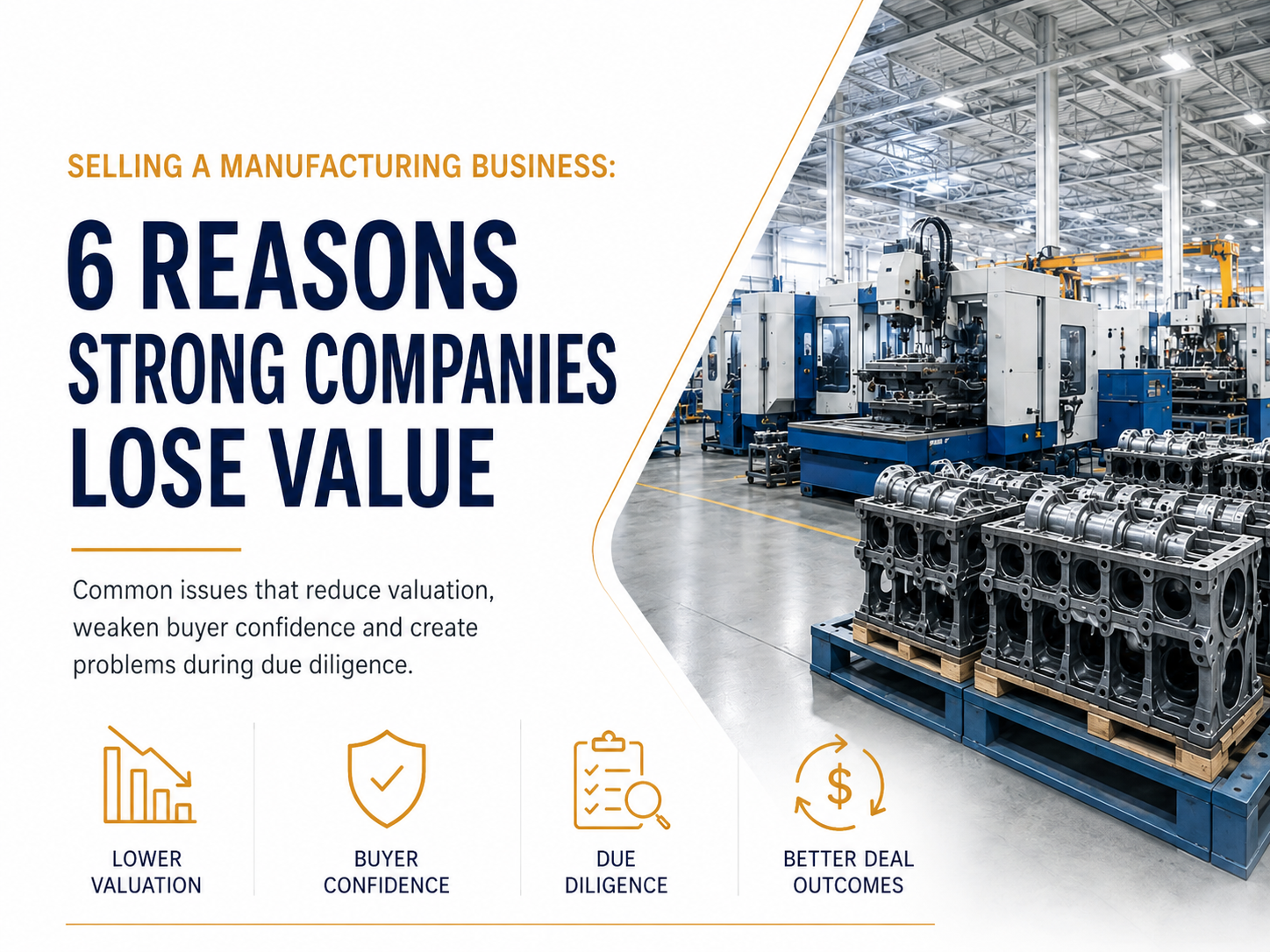
Many SME owners think the sale process begins when the business is listed. In reality, the process starts much earlier.
“What multiple are businesses like mine selling for?”
It is a reasonable question. Unfortunately, it can also be the wrong place to start.
Owners often hear that businesses in their sector sell for four, five or six times EBITDA and naturally begin calculating:
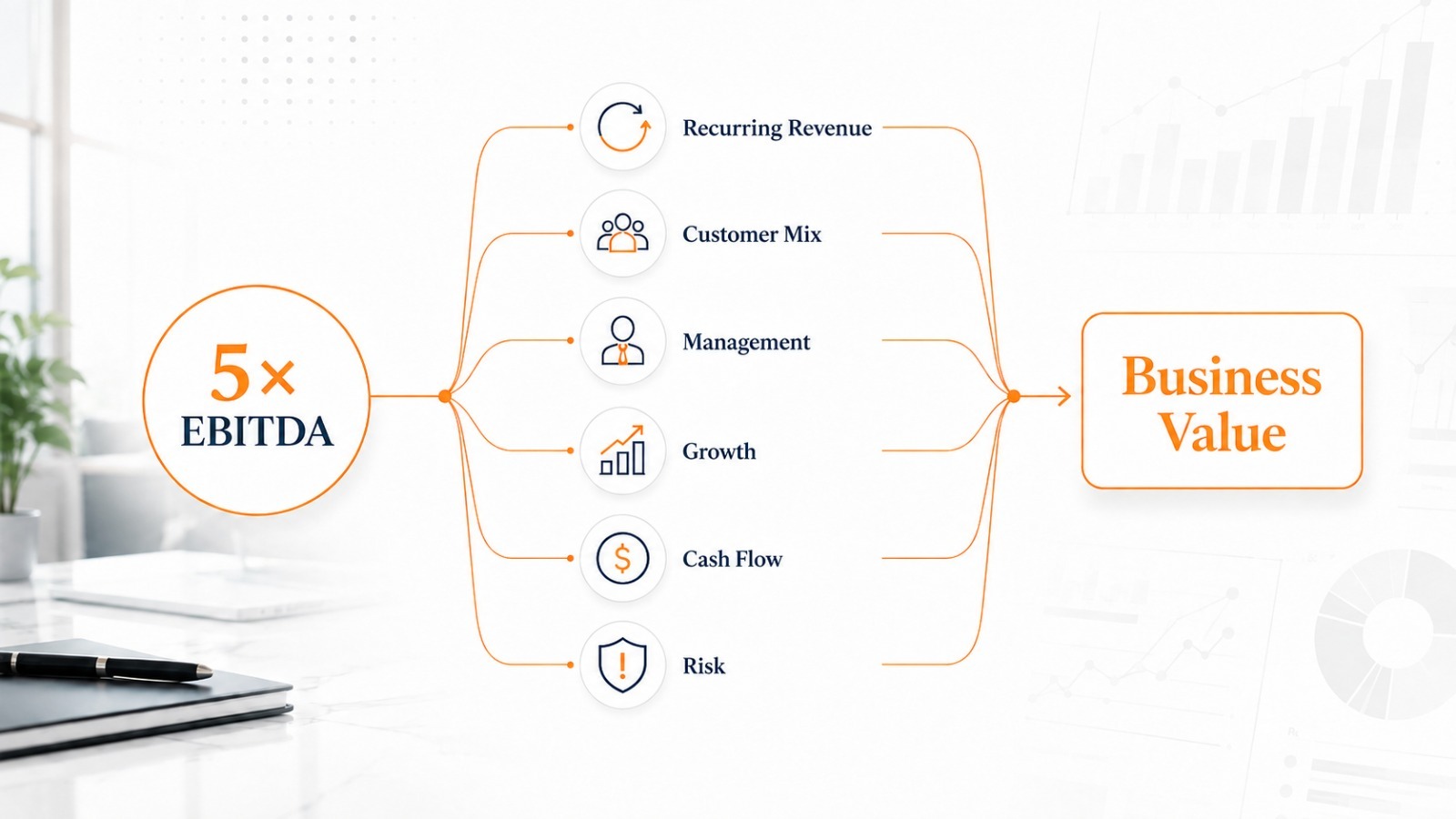
EBITDA × Multiple = Business Value
If EBITDA is $1 million and the market multiple is 5×, the business must therefore be worth $5 million.
In reality, private company valuation is rarely that simple.
Two companies operating in the same industry, generating identical revenue and reporting identical EBITDA, can command substantially different valuations.
Why?
Because buyers are not simply purchasing historical EBITDA.
They are purchasing the future cash flow, sustainability, risk profile and growth potential behind that EBITDA.
Consider Two Businesses
Imagine two Canadian manufacturing companies.
Both generate:
- Revenue: $10 million
- EBITDA: $1.5 million
- EBITDA margin: 15%
At first glance, they appear almost identical.
Yet Company A receives offers around 4× EBITDA, while Company B attracts interest closer to 6×.
That represents a difference of approximately $3 million in enterprise value, despite both companies reporting the same EBITDA.
The difference may lie in factors that do not immediately appear on the income statement.
1. Customer Concentration
Suppose Company A generates 40% of its revenue from one customer.
Company B’s largest customer represents only 8%.
From a buyer’s perspective, these are very different businesses.
If Company A loses its largest customer shortly after acquisition, a significant portion of EBITDA could disappear.
The buyer therefore has to price that risk.
Customer diversification does not always increase EBITDA, but it can increase the quality of EBITDA, which can directly influence valuation.
2. Recurring and Predictable Revenue
Buyers generally place greater value on revenue they believe will continue after the transaction.
A company with long-standing service contracts, maintenance agreements, recurring orders or predictable customer relationships may command a premium over another company relying predominantly on one-off projects.
This is particularly important for business owners preparing for an eventual sale.
The question is not only:
“How much revenue are we generating?”
It is also:
“How much of next year’s revenue can a buyer reasonably predict today?”
Predictability reduces risk.
Reduced risk can improve valuation.
3. Dependence on the Owner
This can be one of the largest hidden valuation issues in privately owned businesses.
Many successful entrepreneurs are deeply involved in:
- Customer relationships
- Pricing
- Supplier negotiations
- Hiring
- Sales
- Operations
- Financial decisions
That involvement may have helped create the business.
Unfortunately, it can also create a problem when the owner wants to leave.
A buyer may reasonably ask:
“What happens to this company when the owner is no longer here?”
If most commercial knowledge, key customer relationships and decision-making sit with one individual, the buyer is not simply acquiring a business.
The buyer may also be acquiring a dependency.
A strong management team and credible second tier of leadership can therefore become genuine valuation assets.
4. The Quality of Financial Information
A profitable company with weak financial reporting can still create significant concern during a sale process.
Buyers want to understand:
- Monthly performance
- Gross margins
- Customer profitability
- Working capital
- Capital expenditure
- Inventory
- Cash conversion
- Historical trends
If reliable information cannot be produced quickly, buyers begin questioning what else they may not know.
Good financial reporting does more than support due diligence.
It creates confidence.
And confidence has commercial value during a transaction.
5. EBITDA Adjustments
Reported EBITDA and maintainable EBITDA are not always the same.
Private businesses frequently contain expenses that may legitimately be adjusted when calculating normalized earnings.
Examples can include:
- Excess owner compensation
- Personal expenses
- One-time professional fees
- Unusual litigation costs
- Non-recurring restructuring expenses
- Costs associated with discontinued activities
This is also where a value-enhancing checklist can help. It forces the owner to identify what could improve value before launch.
However, there is an important distinction between a defensible adjustment and an optimistic one.
Buyers and their advisers will test every material adjustment.
For example, if a business reports EBITDA of $1.2 million but has $200,000 of legitimate adjustments, normalized EBITDA may be $1.4 million.
At a 5× multiple, that difference potentially represents $1 million of additional enterprise value.
This is why understanding EBITDA properly before going to market is so important.
6. Growth Prospects
Buyers generally pay for what a business has achieved, but valuation is also influenced by what they believe it can become.
A company demonstrating consistent organic growth, untapped geographical opportunities, excess production capacity or cross-selling potential may attract a stronger valuation.
Conversely, a company whose revenue has remained flat for several years may still be profitable, but buyers may question where future growth will come from.
The strongest businesses can demonstrate both historical performance and a credible pathway for future growth.
7. Capital Expenditure and Working Capital
Not all EBITDA converts equally into cash.
A business generating $2 million of EBITDA but requiring constant machinery replacement, heavy inventory investment or significant working capital may produce less free cash flow than another company generating the same EBITDA.
Sophisticated buyers understand this.
They therefore look beyond the headline profitability number and examine how much capital is required to sustain the business.
This is particularly relevant in manufacturing and distribution companies.
The Multiple Is Usually the Result, Not the Starting Point
Business owners frequently focus on negotiating a higher multiple.
But often the better strategy is to improve the characteristics of the business that justify a higher multiple.
A buyer may pay more for a company with:
- Diversified customers
- Recurring revenue
- Strong management
- Reliable financial information
- Sustainable margins
- Low owner dependency
- Clear growth opportunities
- Predictable cash flow
None of these factors operates independently.
Together, they influence how a buyer perceives risk.
And ultimately, valuation is largely a reflection of risk, quality and future opportunity.
Preparing for Value Before Preparing for Sale
For an owner contemplating a transaction in the next two or three years, valuation work should begin long before the company is marketed.
The objective should not simply be to increase EBITDA.
It should be to improve the quality and transferability of the business.
That may mean strengthening management, reducing customer concentration, improving reporting, formalizing contracts, developing recurring revenue or documenting processes.
In many cases, these improvements make the company stronger even if the owner ultimately decides not to sell.
So when someone says:
“Businesses in your industry are selling for 5× EBITDA,”
the right response may be:
“Which businesses — and why?”
Because ultimately, your company is not worth a multiple.
It is worth what a well-informed buyer is prepared to pay for the quality, sustainability and future potential of the business behind the numbers.