A manufacturing business can be profitable, respected and growing – and still lose value during an M&A process.
This often surprises owners.
They may have spent 20 or 30 years building customer relationships, developing products, training employees and investing in machinery. From the owner’s perspective, the value of the business is clear.
A buyer looks at it differently.
The buyer is not only asking what the business earned last year. They are asking whether those earnings will continue after ownership changes.
- Can the business operate without the owner?
- Are the customers secure?
- Is the inventory accurately valued?
- Will major equipment need replacing?
- Are the margins reliable?
- Can the financial information withstand detailed review?
A strong business can therefore receive a lower offer – not because it is a bad business, but because the buyer sees risks that have not been properly addressed.
The direct answer
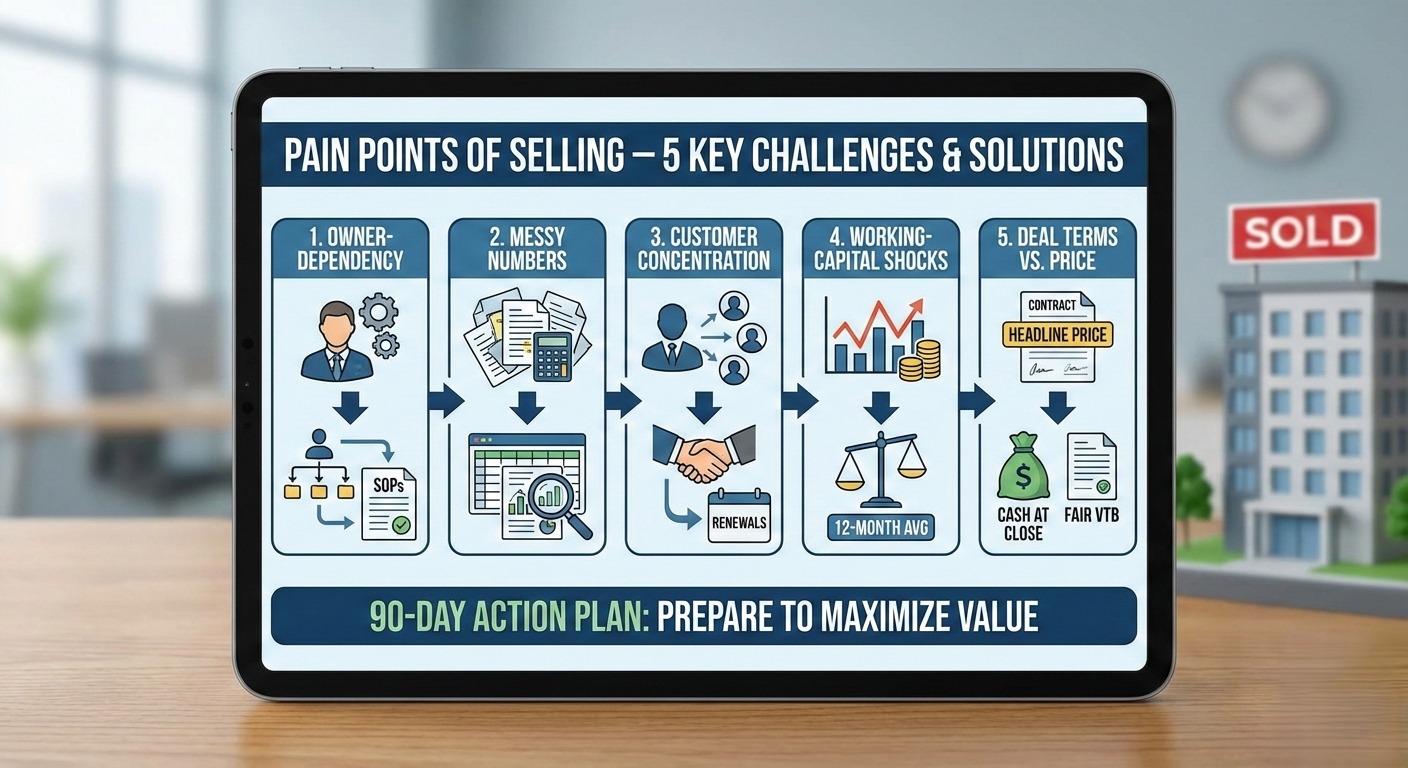
Strong manufacturing businesses commonly lose value because of weak financial reporting, customer concentration, unreliable inventory records, owner dependence, unclear capital expenditure requirements and late preparation.
These issues increase uncertainty. Greater uncertainty usually causes buyers to reduce their offer, ask for an earn-out, retain part of the price, or demand more protection in the purchase agreement.
Six issues that can reduce the value of a manufacturing business
| Issue | What concerns the buyer | Possible effect on the deal |
|---|---|---|
| Weak financial reporting | Earnings cannot be fully understood or verified | Lower valuation |
| Customer concentration | Revenue may fall if a major customer leaves | Earn-out or holdback |
| Poor inventory records | Stock may be obsolete or overstated | Purchase-price adjustment |
| Owner dependence | Performance may decline after the owner exits | Longer transition period |
| Unclear capital needs | Buyer may face major expenditure after closing | Reduced offer |
| Late preparation | Problems cannot be corrected before due diligence | Delay or failed transaction |
1. The financial information does not explain the business
Annual financial statements may be sufficient for tax and banking purposes. They are rarely enough for an M&A process.
A buyer will usually want to understand:
- sales and gross margin by customer
- profitability by product or product group
- labour and overhead costs
- monthly performance trends
- unusual or non-recurring expenses
- customer rebates and discounts
- working-capital requirements
- the basis of management forecasts
Financial due diligence examines the quality and sustainability of earnings, working-capital requirements, cash flows and debt-like items.
In our work with owner-managed businesses, we often find that owners understand their business extremely well but hold much of that knowledge in their heads. They can explain which customers are profitable and which products create operational difficulties, but the reports do not always show it clearly.
A buyer cannot rely on the owner’s memory alone. The information must be supported by reliable financial and operational data.
When the numbers are difficult to explain, the buyer does not normally assume the best. The buyer builds more caution into the valuation and deal terms.
2. Too much revenue depends on one or two customers
Customer concentration is common in manufacturing.
A company may have served one large customer successfully for many years. The relationship may feel secure, but a buyer will still ask:
- Is there a written contract?
- How easily can the customer change suppliers?
- Is the relationship with the business or mainly with the owner?
- What percentage of revenue and profit comes from this customer?
- Has the customer’s purchasing pattern changed?
- What would happen if the account were lost?
Customer concentration can affect business value. Where possible, the risk should be understood and addressed before a sale.
It may not be realistic to replace or materially reduce a major customer before going to market. However, the seller should be able to demonstrate the strength of the relationship through order history, contracts, renewal patterns, switching costs and future pipeline.
The problem is not always concentration itself. The greater problem is concentration that has not been properly analysed or explained.
3. Inventory creates a late and costly disagreement
Inventory is often one of the most difficult areas in a manufacturing transaction.
The balance sheet may show a significant inventory value, but the buyer will want to know:
- How much stock is slow-moving?
- Is any inventory obsolete?
- Are raw materials vstill usable?
- Is work in progress valued correctly?
- Can finished goods be sold at normal margins?
- Is excess stock being held for discontinued products or former customers?
Buyers also examine the normal level of working capital required to operate the company after closing. Working-capital analysis is a standard part of financial due diligence and can directly affect the final purchase-price adjustment.
A seller may believe that all inventory should be paid for in addition to the agreed business value. The buyer may argue that a normal level of inventory is already required to generate the earnings being purchased.
Unless this is analysed and agreed early, it can create a major dispute shortly before closing.
4. The company still depends too heavily on the owner
Many successful manufacturing owners remain central to daily operations.
They may personally manage:
- major customer relationships
- pricing decisions
- supplier negotiations
- production issues
- quality concerns
- hiring decisions
- capital purchases
- technical knowledge
This may have helped the company succeed. But it also creates transition risk.
A buyer wants confidence that customers, employees and suppliers will remain after the owner leaves. The ability of a business to operate without its current owner is an important factor in sale negotiations and valuation.
A business is generally easier to sell when it has:
- a capable management team
- clear decision-making authority
- documented operating procedures
- reliable management reporting
- customer relationships shared across the team
- technical knowledge that is not held by one person
The owner does not need to become uninvolved overnight. The objective is to show that the business can continue performing when ownership changes.
5. Equipment and future capital spending are unclear
Manufacturing owners often place significant value on their machinery and equipment.
Buyers are less interested in what the equipment originally cost. They are more concerned with:
- present condition
- maintenance history
- remaining useful life
- production capacity
- downtime
- replacement requirements
- environmental or safety compliance
- future capital expenditure
Due diligence commonly reviews capital expenditure trends and distinguishes between spending required to maintain current operations and investment intended to support future growth.
If the buyer believes that major equipment will need replacing shortly after closing, this may reduce the offer.
A well-maintained equipment register, preventive maintenance records and a realistic capital plan can give buyers greater confidence.
6. The owner begins preparing too late
This is often the biggest problem.
Some owners only start preparing after a buyer has approached them or an offer has been received.
By then, there may not be enough time to:
- improve financial reporting
- reduce owner dependence
- address customer concentration
- clean up obsolete inventory
- strengthen management
- document processes
- resolve legal, tax or environmental issues
Starting early can help maximize value and simplify negotiations.
Starting early does not mean committing to a sale. It means creating options.
What manufacturing owners should do before going to market
An owner considering a sale within the next 12 to 36 months should begin by asking:
- Can we clearly explain our sustainable EBITDA?
- Do we know profit by customer and product group?
- Is our inventory properly classified and supported?
- Can the management team operate without the owner?
- Are customer and supplier concentration risks understood?
- Is our equipment and capital expenditure plan current?
- Could we respond confidently to buyer due diligence?
No manufacturing company is perfect. Buyers do not expect perfection.
They do expect the seller to understand the company’s risks, explain them honestly and demonstrate how they are being managed.
Frequently asked questions
How early should I prepare a manufacturing business for sale?
Preparation should ideally begin well before formal buyer outreach. A period of 12 to 36 months gives the owner more opportunity to improve reporting, strengthen management and address issues that may reduce value.
What financial information will buyers request?
Buyers commonly request historical financial statements, monthly management accounts, sales and margins by customer or product, inventory records, working-capital information, forecasts and details of owner-related or non-recurring expenses.
Does valuable machinery automatically increase the sale price?
Not necessarily. Buyers consider the equipment's condition, usefulness, maintenance record, remaining life and future replacement cost. They also assess whether the equipment is already required to generate the earnings included in the valuation.
Can a business be sold if it depends heavily on the owner?
Yes, but owner dependence may affect valuation, deal structure and the transition period. Reducing that dependence before going to market can improve buyer confidence.
A strong business deserves a strong sale process
A profitable manufacturing business can still lose value if buyers cannot clearly understand its earnings, operations and future risks.
Preparation allows the owner to control the story rather than react to concerns raised during due diligence.
At Cannar M&A, we help manufacturing owners assess sale readiness, identify potential value gaps, position the business properly and manage a confidential process with serious buyers.
Considering a sale in the next 12 to 36 months?
Start with a confidential discussion about how buyers may view your business and what can be improved before going to market.
About the author
Syed M. Irfan, Managing Partner, Cannar M&A
Syed M. Irfan is a Chartered Accountant and an experienced CFO with more than 30 years of international financial, operational and M&A experience, including extensive work in manufacturing environments. He holds an Executive MBA from the Richard Ivey School of Business at the University of Western Ontario, now known as Ivey Business School at Western University.