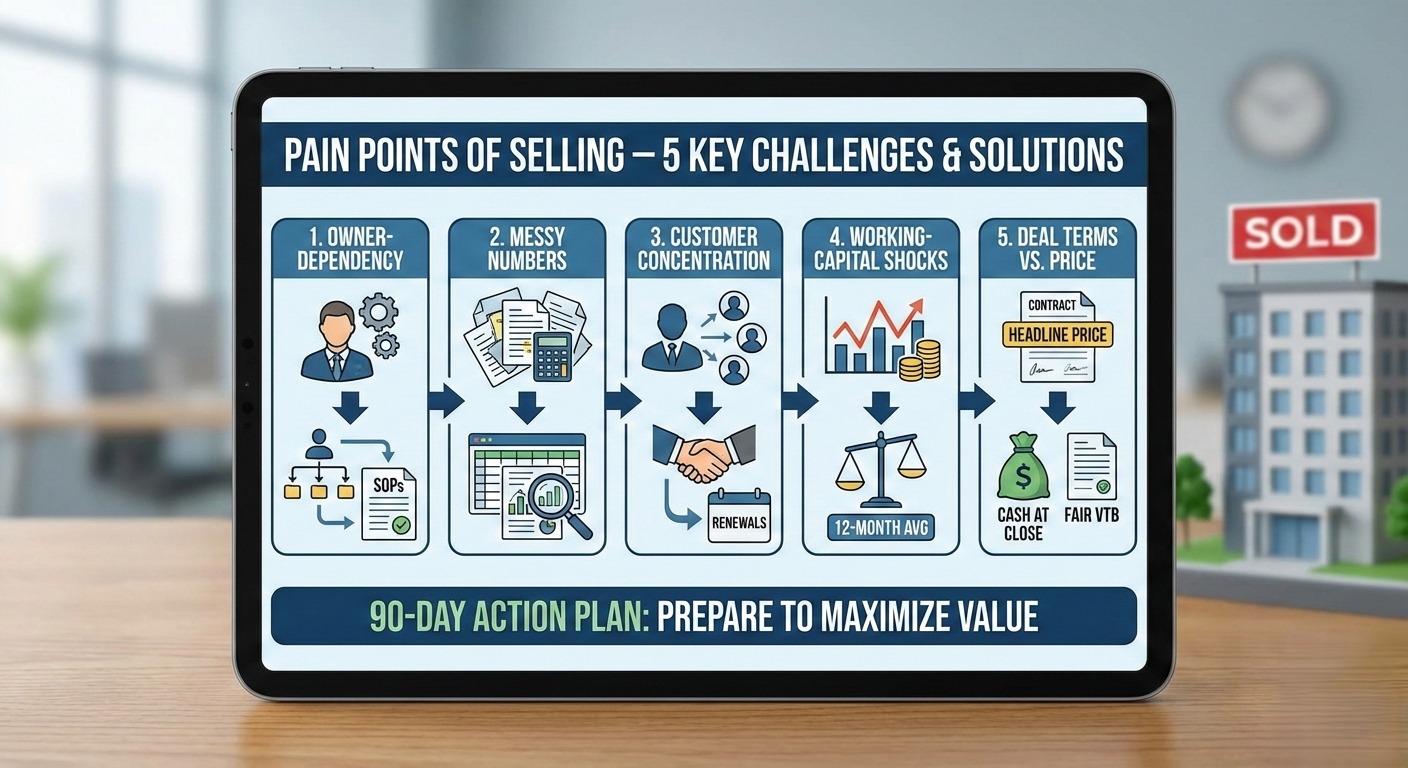
Executive Summary
Many SME owners think the sale process begins when the business is listed. In reality, the process starts much earlier.
The businesses that attract stronger buyers, move faster through due diligence, and achieve better outcomes are usually the ones that are well prepared before they go to market. Preparation is not just about tidy accounts. It is about presenting a business that looks stable, transferable, and ready for the next stage of growth. Buyers want confidence. They want to see clear financials, reliable operations, documented processes, a capable team, and a realistic growth story.
This is why business sale preparation matters. It reduces uncertainty, strengthens negotiating power, and often improves SME valuations.
This article outlines a practical framework for preparing a business for sale and highlights the steps owners should take 12–24 months before launch.
1. Start with the Buyer’s Perspective
Owners usually know their business very well. Buyers, however, see it differently.
A buyer is not only asking, “How profitable is this business?” They are also asking:
- Can this business run without the owner?
- Are the numbers reliable?
- Is the customer base stable?
- Are there any legal or operational risks?
- Is there a realistic path to growth after acquisition?
A business may be successful in practice but still look risky in a sale process if the information is unclear or too much depends on the owner.
That is why preparation should begin by stepping back and reviewing the business through a buyer’s eyes.
2. Focus on the Five Core Workstreams
| Workstream | What Buyers Want to See | Typical Preparation Actions |
|---|---|---|
| Financial | Clear, credible, and consistent numbers | Clean up accounts, normalize EBITDA, prepare monthly management reports |
| Operational | A business that runs on systems, not memory | Document processes, build SOPs, reduce owner dependency |
| Commercial | Stable customers and believable growth potential | Analyze customer mix, margins, repeat business, and pipeline |
| Legal & Compliance | No hidden surprises | Review contracts, leases, licenses, and compliance matters |
| Management & Transition | A smooth handover with limited disruption | Clarify team roles, retention plans, and seller transition support |
These five workstreams are where most value is either protected or lost.
3. Clean Up the Financial Story
For many buyers, the financial section is where confidence is either built or weakened.
The goal is not just to show profit. It is to show a business that is understandable.
This means:
- producing reliable monthly financial statements
- separating personal or one-off expenses from true operating costs
- explaining margin trends clearly
- showing working capital patterns
- preparing a sensible forecast, not an optimistic one
If EBITDA needs normalization, it should be done properly and supported with logic. If revenue is seasonal, explain it. If margins changed because of one large project, explain that too.
A buyer is more comfortable paying a stronger multiple when the financial story is clear and credible.
This is one of the most important parts of business sale preparation.
4. Reduce Owner Dependency
One of the biggest risks in SME transactions is owner dependency risk.
If the owner controls all key customer relationships, approves every major decision, solves every operational problem, and holds important knowledge in their head, buyers will see fragility.
That does not mean the business cannot be sold. It means the business may sell at a lower value, or require a longer transition.
To reduce this risk, owners should:
- delegate decision-making where possible
- strengthen second-line management
- document core processes
- introduce key staff to important customers and suppliers
- gradually step back from day-to-day firefighting
A business that runs through systems and people is more attractive than one that runs through the owner alone.
5. Organize Legal and Operational Documentation
Preparation often slows down because important documents are incomplete, outdated, or difficult to find.
Before going to market, owners should review:
- lease agreements
- supplier and customer contracts
- employment agreements
- licenses and permits
- shareholder documents
- insurance coverage
- intellectual property ownership, where relevant
Operationally, it helps to document how the business works in practice.
This includes:
- sales process
- purchasing process
- inventory handling
- customer onboarding
- quality control
- warranty or service procedures
Simple SOP templates can go a long way. They do not need to be perfect. They just need to show that the business is organized and transferable.
6. Strengthen the Commercial Story
A buyer does not only buy past performance. They buy future potential.
That is why the commercial story matters.
Owners should be ready to explain:
- who the main customer groups are
- how concentrated the customer base is
- what the retention pattern looks like
- which products or services generate the strongest margins
- where growth can come from after the sale
This is also where a value-enhancing checklist can help. It forces the owner to identify what could improve value before launch.
For example:
- reducing reliance on one or two customers
- improving pricing discipline
- discontinuing low-margin products
- strengthening digital presence
- showing a more structured sales pipeline
The stronger the growth story, the stronger the buyer interest.
7. Build a Practical Sale Timeline
| Phase | Focus | Example Actions |
|---|---|---|
| 12–24 months before sale | Value building | Improve reporting, reduce owner dependency, fix weak areas |
| 6–12 months before sale | Sale readiness | Prepare CIM inputs, organize documents, test valuation assumptions |
| 0–6 months before launch | Market preparation | Finalize presentation materials, buyer list, data room, and negotiation strategy |
This kind of roadmap improves discipline and reduces last-minute stress.
It also gives the owner time to fix issues before they become buyer objections.
8. Avoid the Most Common Mistakes
In our experience, owners most often lose value in one of four ways:
First, they go to market too early, before the business is ready.
Second, they rely on memory instead of documentation.
Third, they overestimate value without testing buyer logic.
Fourth, they underestimate the importance of transition planning.
A strong sale does not happen by accident. It is built.
Key Takeaway
Preparing a business for sale is not a single task. It is a structured process that improves clarity, reduces risk, and strengthens value.
The best-prepared businesses usually have:
- cleaner financial reporting
- lower owner dependency risk
- better process documentation
- stronger management depth
- a believable commercial growth story
- a clear SME sale roadmap
That is what buyers want to see.
At Cannar M&A, we work with SME owners to prepare their businesses properly before going to market, so they are not just ready to sell — they are ready to sell well.